Why Your Web Hosting Matters, and Why We’ve Used WP Engine for 10+ Years
Security and support matter more than price when you choose web hosting. Here is what downtime really costs, and why Sprung has hosted WordPress on WP Engine for more than 10 years.
 Clay Johnston · 6 min read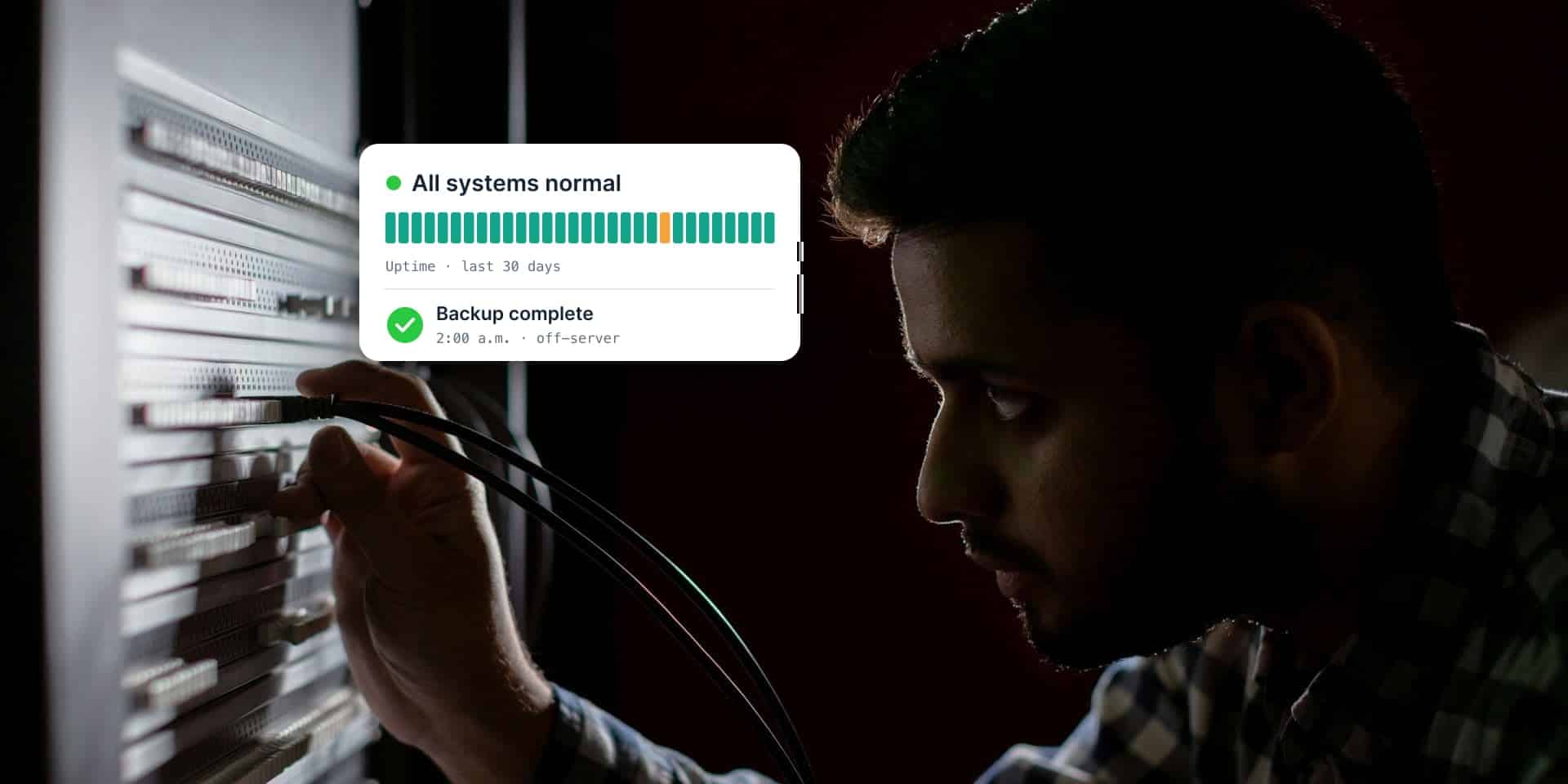
The short version
- Your web hosting decides whether your site stays up, loads fast, and survives an attack.
- Security and support matter more than the monthly price.
- Downtime and security problems cost real money: lost sales, wasted ad spend, cleanup bills, and lost trust.
- Sprung has hosted its core WordPress sites on WP Engine for more than 10 years.
- For other projects, we use AWS and Cloudflare for CDN and caching, plus Vercel, Supabase, Clerk, and RevenueCat.
Most businesses choose web hosting by price. On paper, that makes sense. Hosting is invisible when it works, so why pay more for it?
Because you notice it the day it breaks. The site goes down in the middle of a sale, or a plugin gets hacked and Google starts warning visitors away. You call support. You get a ticket number.
I started Sprung Interactive in Minneapolis in 2010. For more than 10 years, our core WordPress hosting has run on WP Engine. Here’s why, and what to look for in a host whether you work with us or somebody else.
What does a web host actually do?
A web host stores your site’s files and database on servers connected to the internet. When someone types in your address, the server sends them your pages. That’s the job, in theory.
Good hosting does a lot more. It keeps server software patched, blocks attacks, makes backups, handles traffic spikes, and answers the phone when something breaks. A cheap host may do the first part well and skip the rest.
WordPress raises the stakes. W3Techs (opens in a new tab) puts WordPress at 40.1% of all websites, which makes it the most popular target on the web. So WordPress web hosting has to be built with attackers in mind.
How does downtime hurt your bottom line?
A site that’s down can’t sell, book appointments, or collect leads. The math is simple. Say your site brings in $20,000 a month in online orders. That’s about $28 an hour, every hour. A two-day outage over a weekend costs you about $1,300 in sales.
And that’s only the direct loss. Your ads keep running and keep sending paid clicks to an error page while your staff drops everything to answer calls and emails. Some customers who find a dead site may not come back. Search engines notice too. If they keep hitting errors, they visit your site less often, and a long outage can drop pages from search results.
Bigger companies feel it more. ITIC’s 2024 survey (opens in a new tab) of more than 1,000 firms found that one hour of downtime costs over $300,000 for more than 90% of mid-size and large enterprises.
No host can promise zero downtime. Good web hosting makes outages rare and short, and someone knows the moment one starts.
Why is security the first thing to check?
WordPress itself is solid. The risk lives in plugins and themes. Patchstack counted 11,334 new WordPress vulnerabilities in 2025 (opens in a new tab), up 42% from 2024. Plugins accounted for 91% of them. Almost half, 46%, had no fix from the developer when they went public. And for the most targeted flaws, attackers started exploiting them a median of five hours after disclosure.
Five hours. Most of us take longer than that to answer a text from our accountant.
A breach costs money even when it’s small. IBM’s 2026 Cost of a Data Breach Report (opens in a new tab) puts the global average at $4.99 million. A local business would see a much smaller bill: cleanup, sales lost while the site is offline, and the time it takes to win customers back. If Google flags your site as hacked, visitors see a warning before they see your homepage.
Secure hosting stops a lot of this before it starts. WP Engine patches its servers and keeps WordPress core and PHP, the programming language WordPress runs on, up to date. It includes free SSL certificates, the padlock in the browser bar, and backs up every site daily. We add our own layer on top: weekly full-site backups stored off the server, daily database backups, 24/7 uptime monitoring, and scans for malicious code and unauthorized redirects. Our security audits cover the parts a host can’t see, such as old plugins and user accounts nobody remembers creating.
Why does web hosting support matter so much?
Something will go wrong eventually. A plugin update breaks a page, a form stops sending, or traffic triples after a news story. When it does, support is what you’re really paying for.
Budget web hosting often sends you through a ticket queue and a script. You explain the problem three times, get told to clear your cache, and wait. WP Engine’s support team knows WordPress, works around the clock, and fixes problems instead of passing them along. Over more than a decade, they’ve been one of our most valuable partners, and their support is the biggest reason.
Our clients get a second layer. They call us, and we already know their site. If the problem is on the server side, we work it out with WP Engine directly. One person to call. No phone tree.
Does cheap web hosting really cost less?
Everyone says you get what you pay for. Hosting is no exception.
Low-cost shared web hosting puts hundreds of sites on the same server. When one of them gets a traffic spike or gets hacked, the others can slow down with it. Many budget plans also advertise a low first-term price that goes up at renewal, then charge extra for backups, SSL, or malware removal.
Now add up one bad outage or one hacked site. The few dollars a month you saved are gone the first time your site is down for a day.
You don’t need the most expensive plan, either. Compare hosts on uptime, security, backups, and support first. Price comes second.
Why has Sprung stayed with WP Engine for over 10 years?
It keeps working. Sites stay up, updates go smoothly, and support answers. Over 10 years, that consistency matters more than any feature list.

Today all of our core WordPress hosting runs on WP Engine, on Google Cloud, with dedicated resources for our sites. Those resources are ours alone, so your site isn’t fighting hundreds of strangers for speed. Cloudflare’s network serves pages from servers close to each visitor.
For our development clients, hosting with us started as a convenience. We build the site and host it in the same place, so launch day is simple. They stay for a different reason. Our hosting clients stick with us for years because the hosting is reliable and consistent, and nobody wants to move a site that never gives them trouble.
Does Sprung only use WP Engine?
WP Engine is our home for WordPress sites. For everything else, we pick the platform that fits the job:
- AWS and Cloudflare: CDN and caching, so files and pages load from servers near each visitor.
- Vercel: hosting for fast websites and web apps built outside WordPress.
- Supabase: databases and back ends, the server side of web and mobile apps.
- Clerk: user sign-in and account management.
- RevenueCat: subscriptions and in-app purchases for mobile apps.
The site you’re reading uses two of them: WordPress on WP Engine stores the content, and Vercel serves the pages. Each one does the part it does best.
What should you ask before you choose a web host?
- How often do you back up my site, where are the backups stored, and how fast can you restore one?
- What happens when one of my plugins has a known security hole?
- Is support available 24/7, and does it know WordPress?
- Is my site on a shared server? How many other sites share it?
- What will the plan cost at renewal, and what costs extra?
- Who watches for downtime, and how fast will I hear about it?
If a host can’t answer those clearly, keep shopping.
Want web hosting you don’t have to think about?
We host and look after WordPress sites on WP Engine. We can move yours over, timed to avoid downtime, or care for it where it lives now. Either way, you get one person to call who already knows your site.
See the sites we build and support in our work, or read more about hosting and care. Then tell us about your site, and we’ll recommend a plan that fits.
Frequently asked questions
What does a web host do?
A web host stores your site's files and database on servers connected to the internet and sends your pages to visitors. Good hosting also patches server software, blocks attacks, makes backups, handles traffic spikes, and gives you support when something breaks.
Is WP Engine good for WordPress sites?
We think so. Sprung has hosted its core WordPress sites on WP Engine for more than 10 years. Support is the biggest reason: a team that knows WordPress, around the clock. WP Engine also patches its servers, updates WordPress core and PHP, includes free SSL, and backs up every site daily.
How much does website downtime cost?
It depends on what your site brings in. A site with $20,000 a month in online orders loses about $28 an hour, or about $1,300 over a two-day outage. ITIC's 2024 survey found one hour of downtime costs over $300,000 for more than 90% of mid-size and large enterprises.
Is cheap web hosting worth it for a business?
Usually not. Low-cost shared hosting puts hundreds of sites on one server, and many budget plans raise the price at renewal or charge extra for backups, SSL, or malware removal. One bad outage or hacked site can wipe out what you saved.
Can Sprung move my WordPress site to WP Engine?
Yes. We move sites timed to avoid downtime. If you'd rather stay where you are, we can care for your site on its current host instead.

Written by Clay Johnston
Founder of Sprung Interactive in Minneapolis. Building for the web since 1995 and still answering his own email. More about Clay